







SEARCH SITE

FEATURED

OUR SPONSORS
TWITTER
LINKS

MORE FEATURED


TAGS
Abandoned Disney (8) Adventure Thru Inner Space (2) Adventureland (12) America Sings (1) Animal Kingdom (2) Animation (19) Animatronics (20) Area Music (7) Backyard Imagineering (5) Behind-the-Scenes (39) Big Thunder Mountain (2) California Adventure (5) Captain E.O. (1) Carousel of Progress (12) Castle (6) Characters (6) Concept (13) Construction (9) Country Bear Jamboree (2) Death (2) Disney Channel (1) Disneyland (45) Disney-MGM Studios (1) Donald Duck (3) Entertainment (5) Epcot (28) Fantasyland (14) Fess Parker (1) Film (25) Frito Kid (4) Frontierland (12) Germany (1) Hall of Presidents (4) Haunted Mansion (10) Hidden Mickeys (2) Holidays (1) Hollywood Studios (1) Horizons (3) House of the Future (1) Illustration (3) Imagineering (1) John Lasseter (4) Journey Into Imagination (2) Jungle Cruise (15) Lake Buena Vista (1) Liberty Square (3) Lillian Disney (2) Ludwig Von Drake (1) Magic Kingdom (21) Main Street U.S.A (10) Maintenance (1) Management (5) Maps (12) Marc Davis (8) Marty Sklar (3) Matterhorn (3) Monorail (2) Mr. Lincoln (3) Muppets (2) Music (3) Mystery (9) Nature's Wonderland (7) New Orleans Square (5) Orange Bird (2) Paul Frees (1) PeopleMover (6) Peter Pan (2) Photos (1) Pirates of the Caribbean (9) Pixar (5) Pleasure Island (1) Podcast (1) Progress City (1) Props (2) Railroad (2) Resorts (1) River Country (4) Rivers of America (2) Roy Disney (1) Scale Models (17) Skyway (3) Song of the South (2) Sound Effects (2) Space (3) Space Mountain (3) Splash Mountain (1) Tangled (2) The Living Seas (1) Then and Now (15) Tiki Birds (2) Tilt Shift (2) Tomorrowland (33) Tomorrowland 67 (4) Treehouse (1) Walt Disney (13) Walt Disney Family (6) Walt Disney Family Museum (1) Walt Disney World (6) Ward Kimball (1) Wonders of Life (1) World of Motion (2) World's Fair (2)
MORE MORE FEATURED


Orange Bird Photo Hunt

EVEN MORE FEATURED

ADMINISTRATORS

Entries in Maps (12)

Friday
Aug312012

Tomorrowland '67 [Part 2]

In this part of our Tomorrowland '67 series we break down each attraction into different categories. We learn just how affordable Disneyland was for Southern Californians at the time and we see how long this great Disneyland expansion really lasted.

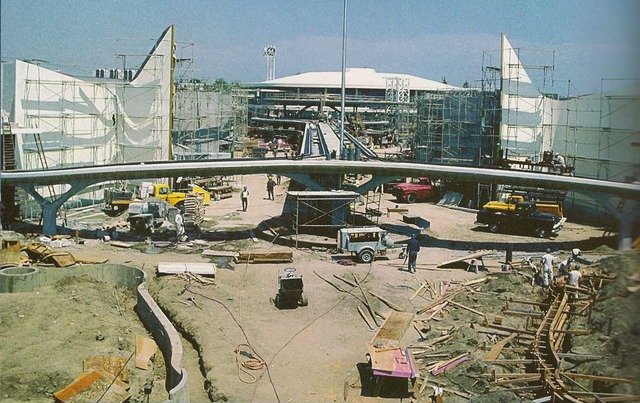
New Tomorrowland opened on July 2, 1967. Most of the previous Tomorrowland structures had been entirely demolished to make way for new or improved attractions. It cost more than $20 million. Remember, just twelve years earlier all of Disneyland cost about $17 million.

Let’s go see what’s new at Disneyland!

You’ve gone through Tomorowland withdrawals for long enough. It’s 1967 and it’s summertime. With Tomorrowland closed all this time you’ve only celebrated the past while visiting Disneyland’s three other lands (plus Main Street). You are ready to once again celebrate the future. You are eager for new rides.

Fill up your family car for $0.30 a gallon and head over to Disneyland. Take a tram over to one of the outer ticket booths and pull out $20. That’s plenty for everyone in your family of four. Better get the 15-ride ticket book just in case. Ticket books in the summer of 1967 cost between $3.50 and $5.50 depending on age and how many tickets you wanted. This included the price admission. If everyone happens to want to ride a couple additional big rides, E-tickets are only $0.75 at the various ticket booths inside the park. Individual D-tickets are only $0.60 each. C-tickets are $0.35, B-tickets $0.25, and A-tickets are only $0.10.

Southern Californians and Disneyland in the 1960s

All my grandparents and both my parents lived in California in the 60s (and beyond). Both sides of the family, though they didn’t know each other yet, had similar Disneyland-related traditions. I imagine most Southern Californians had similar experiences. My family would visit Disneyland every time someone came from out of town to visit. They would keep a shoe box of partially-used ticket books handy for themselves and their guests to use. When no one was visiting, they could pay between $0.75 and $3.00 per person for admission then use the tickets from the shoe box. Did my family, relatives, or their guests take lots of photos and film their many experiences?? Nope. It torments me every time I think of it.

Not my family.

A Review of the Timeline

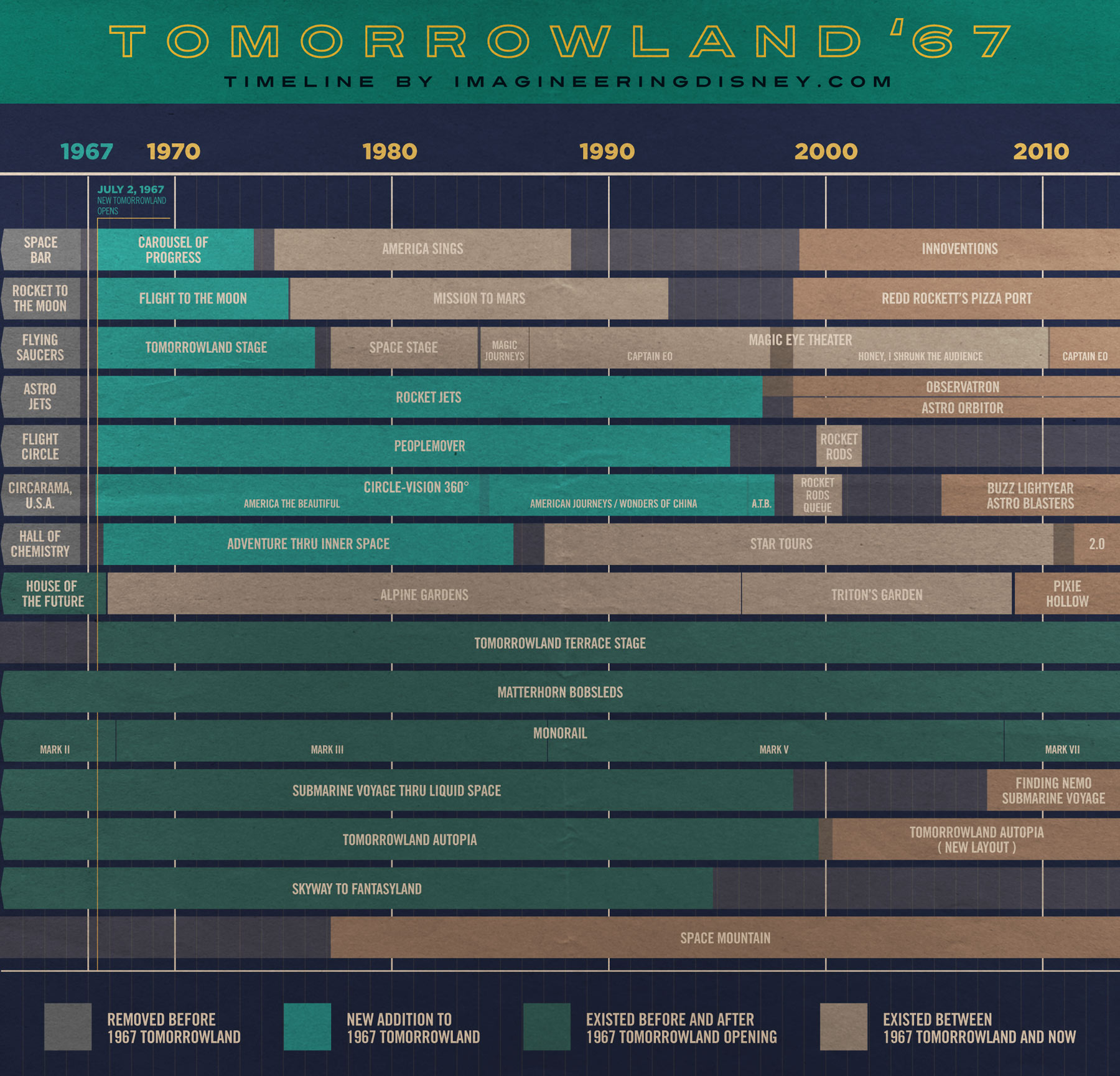
Let's go over the custom timeline we've created above. 

On the far left in gray we see a number of attractions that closed in 1966. The Space Bar was a food location but we've included it to show what occupied the location before Carousel of Progress. To the right of those we see in teal everything that was new to New Tomorrowland. Some of these were not entirely new experiences but they were presented as "new" with good reason. Later in this post we explain why. Below those we see in dark green a number of pre-1967 things that stuck around during and after all 1967 changes. You can see that the House of the Future only overlaps New Tomorrowland for a few months. Were my family member at the park during this precious narrow sliver of time? Probably. Do they remember? No. I wasn't born yet and therefore was unable to be there myself. Thanks, Gorillas, for this photo that lets us pretend we were there for what appears to be the last days of the House of the Future.

Anyway, back to the timeline. The light brown color represents the many attractions that took place between New Tomorrowland and the current Tomorrowland. Some of these were fantastic. Like America Sings! I remember you. You'll notice changes in the mid-90s and especially in 1998 when Tomorrowland's next huge makeover took place. Then come the early 2000s.... Finally I draw your attention to the darker brown color and everything else on the far right. Today we have less gaps than a decade ago. Our beloved subs are traveling deep into the ocean's caves once again. (Yes, I know what you are thinking, but at least you can still climb down those cool metal stairs and watch bubbles rise past your porthole window as you prepare to ride through liquid space. It's better than a lagoon filled with dirt, I tells ya.) And as for the PeopleMover track, I mean the Rocket Rods track (with its center tubular steal thing that PeopleMovers didn't have), it's still standing. And Imagineering reports that it's constantly on their minds. Somehow state safety regulations are getting in the way.


What Happened in Tomorrowland in 1966/67 specifically?

2 entirely new attractions were added:

PeopleMover
Adventure Thru Inner Space

1 attraction was brought in from outside the park:
Carousel of Progress 

3 attractions were improved and renamed:
Rocket to the Moon became Flight to the Moon
Astro Jets became Rocket Jets
Circarama, U.S.A. became Circle-Vision 360° 

1 attraction was to be moved and improved but this never happened:
Flying Saucers were to be build under Space Mountain

1 major attraction was planned but was not built until years later:
Space Port (later named Space Mountain)

2 new stages were built:
Tomorrowland Stage
Tomorrowland Terrace Stage

6 previously-built attractions remained:
House of the Future
Tomorrowland Autopia
Skyway to Fantasyland
Matterhorn Bobsleds
Monorail
Submarine Voyage Thru Inner Space

It’s true, only two entirely new attractions were built for this new land. They were both steady, slow, offered great scenery, and people LOVED them. The PeopleMover and Adventure Thru Inner Space were very popular and still remain a couple of the most-missed Disney rides of all time. The PeopleMover was Disneyland’s fourth way to see a large portion of the park while riding a ride. The Railroad, Skyway, and Monorail also offered views of multiple parts of Disneyland.

Adventure Thru Inner Space was Tomorrowland’s first dark ride and boasted the world’s first Omnimover ride system. The Haunted Mansion with its black “Doom Buggies” normally claims the lion’s share of Omnimover discussions but Inner Space and its blue “Atom Mobiles” opened first. 

Carousel of Progress was new to Disneyland and new to everyone who didn’t make it to New York for the World’s Fair. Plus it was housed in a new building with an upper-level exhibit that the World’s Fair didn’t have. 

Three previously-existing attractions got major facelifts and new names. Rocket to the Moon’s two domed theaters and its curvy building were removed and a new building with a similar layout was built in its place. The ride was enhanced with an animatronic preshow and the ride itself offered new effects. The Astro Jets were removed and a similar spinner ride was built further to the south. This time the rocket ride was all the more fun because of the heights you could reach. It was built on top of the new PeopleMover station. Circarama, U.S.A. was renamed Circle-Vision 360° and got a larger building and better movie projection technology. This time the circular theater was made up of nine screens instead of twelve.

What’s this about an attraction that was supposed to be moved and improved but never happened? Well.... Plans were made for Flying Saucers to be built under what was going to be Space Mountain. The Flying Saucers ride was a part of Tomorrowland for years and was located where Magic Eye Theater (Captain E.O.) and Space Mountain are today. Blueprints show a smaller similarly shaped ride layout further south (refer to our map in Part 1). Hmm. It could be a gift shop for all I know. More on this in later posts.


One major attraction was planned but not built and there are two major reasons for this. Space Port/Space Mountain was a dream of Walt but high costs and a lack of technology required Space Mountain to be delayed.

As it turns out Space Mountain was built first in Walt Disney World's Tomorrowland in Magic Kingdom.

Two new stages were built to liven up the land’s atmosphere with live musical performances. And a very very special broadcast a couple years later.

Six attractions (five of which were rides) remained. Monsanto’s House of the Future (not a ride) had great view of the New Tomorrowland opening celebration but didn’t live to see the new year of 1968. The Skyway was given a new tower. The new tower was an extension of the Carousel of Progress building which happened to be built right next to the old tower . Tomorrowland Autopia, Matterhorn, and Submarine Voyage enjoyed beautiful new surroundings yet experienced few changes themselves as part of New Tomorrowland. 


What a great land it turned out to be. One of the most remarkable themed lands built up to that point. Perhaps the greatest. Disney and More provides this wonderful photo of Muhammad Ali strolling through the north side of New Tomorrowland.

Next time we begin diving into each New Tomorrowland attraction. In our next post we will look at a fan-favorite and its amazing journey. It might be the only Disney attraction to operate in three different parks. You know what I’m talking about...... Walt Disney’s own Carousel of Progress.


Related posts:

Tomorrowland '67 [Part 1]
National Geographic Aug '63 [Part 2]
Not Having Fun at Disneyland
New Fantasyland 1983


Monday
Aug202012

Tomorrowland '67 [Part 1]

In this multi-part series we bring you an attraction-by-attraction look at Disneyland's 1967 "New Tomorrowland" with lots of concept art, photos, maps, diagrams, and history.

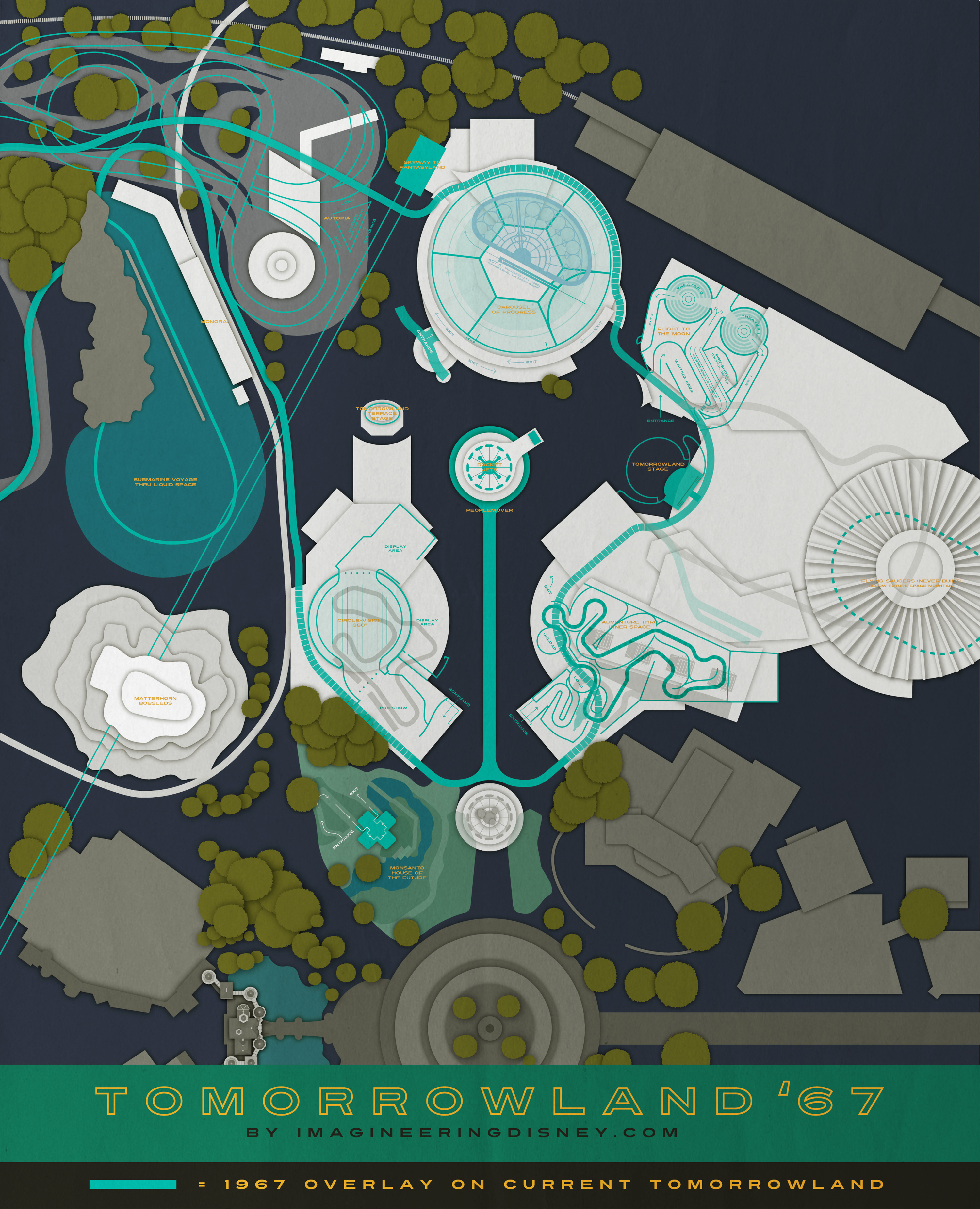
Throughout this series we'll ask you to refer to our custom map above. Click on it for a larger version you can save. Everything in that teal color represents New Tomorrowland of 1967 and everything else is a map of Tomorrowland today.

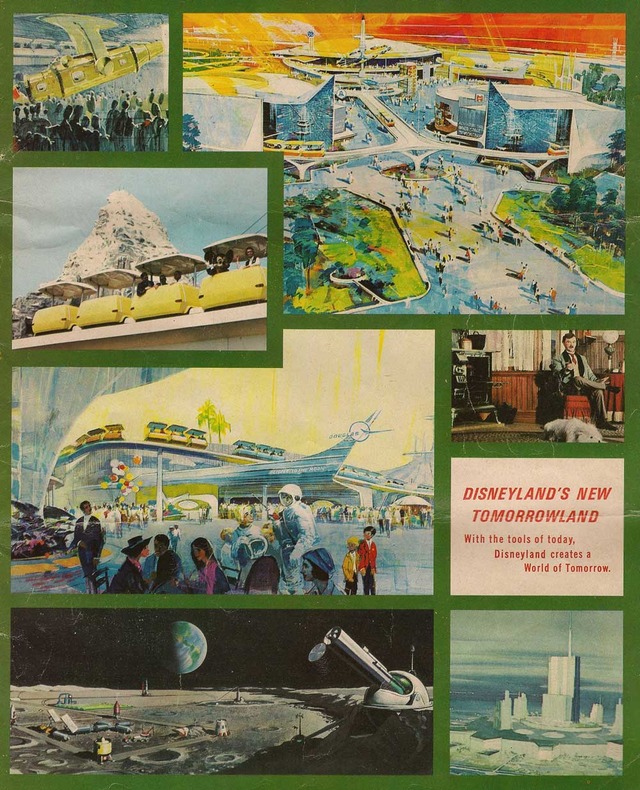
As the summer of 1967 approached, public anticipation increased as news media and printed materials attempted to explain the “new” land. “With the tools of today, Disneyland creates a World of Tomorrow.” “Where the Dreams of the Future are Reality Today." Its opening was advertised as “The most exciting celebration since Disneyland’s opening day July 17, 1955.” 

A “New Tomorrowland”

It was referred to as “New Tomorrowland” and was a long time in the making. The original Tomorrowland offerings of 1955 were rather sparse. The Autopia cars were “everyone’s favorite thing to do in Tomorrowland.” For years Walt Disney felt the under-funded land was not quite “finished”. Walt and his creative people had in mind a much more elaborate land. 

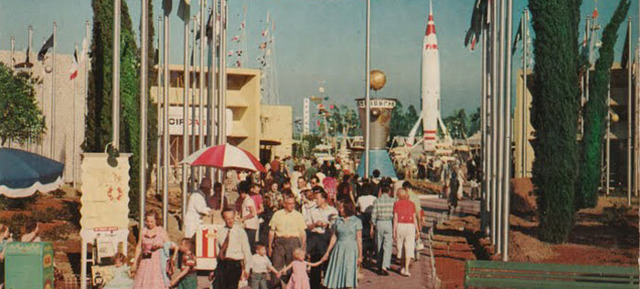
Tomorrowland pre-1967

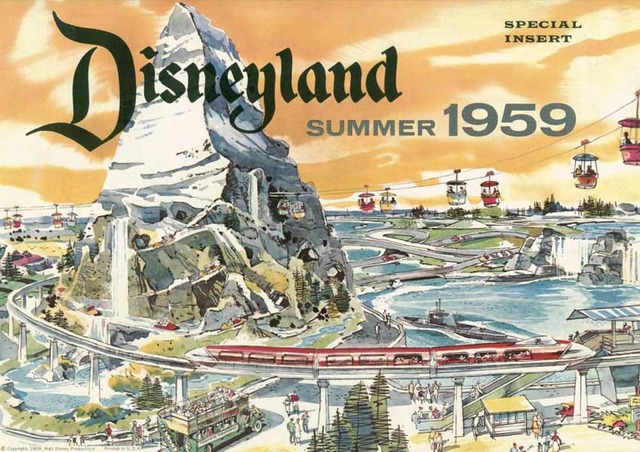
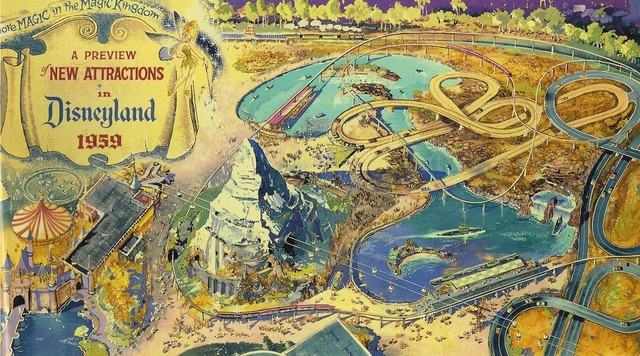
In 1959 the exhibit-heavy original land was enhanced with the addition of the Matterhorn Bobsleds, the Disneyland ALWEG Monorail System, and Submarine Voyage Thru Liquid Space. These additions were fantastic by all accounts. Indeed it was the greatest expansion Disneyland had seen up until that point.

But the bulk of Tomorrowland’s real estate remained the same. By the mid-60s Walt was ready to move beyond exciting topics like dairy! aluminum! and plastic! His fascination with modes of transportation (and perhaps a need for more rides) led to the clean and uniform new design of a Tomorrowland that explored “science and the universe of the future”. It was given a theme nicknamed “World on the Move”.

A “World on the Move”

Transportation in America at this time was an important issue. Cities were growing more crowded. More people were moving to the suburbs. Freeways were being introduced to more and more cities. Air travel was becoming more common. The first “jumbo jet”, the Boeing 747, was soon to take flight. The first manned trip to the moon was just around the corner. 

Walt Disney had commuted from his home in the Los Angeles neighborhood of Holmby Hills to both Disneyland in Anaheim and to The Walt Disney Studios in Burbank. He was working with the Ford Motor Company to build them a pavilion at the 1964-65 New York World’s Fair. He had flown all over the world for both business and for leisure. He was secretly flying to and from Florida in preparation for his “Florida Project”. Transportation was on his mind. 

A Prototype for Walt’s Prototype 

Walt Disney’s “biggest dream” at the time was to build a prototype community called E.P.C.O.T. (Experimental Prototype Community of Tomorrow) on his newly-acquired property in Florida. Transportation was a major focus of E.P.C.O.T.

 It was only logical to test new transportation systems at Disneyland prior to building the city. Smaller-scale systems would double as theme park attractions at the park. Win win.

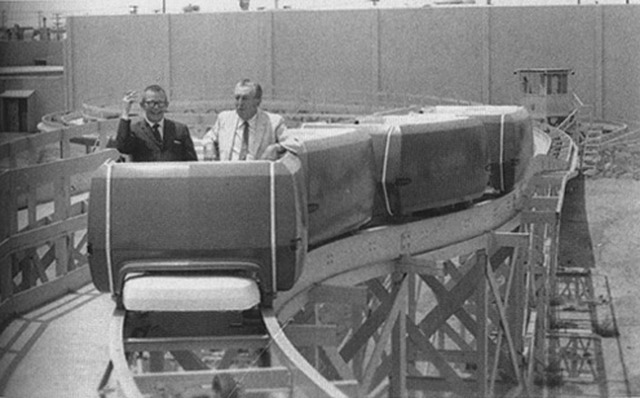
Walt Disney test-riding a PeopleMover on a temporary test track.

A Lot Happening at Once

The mid-60s were by far the most ambitious times for Walt Disney and his themed entertainment projects. Pirates of the Caribbean and Haunted Mansion attractions were in development, the still-secret Florida plans were becoming ever more complex, the four World’s Fair attractions required tremendous time and resources. Plans for New Tomorrowland required an almost unattainable amount of advanced technology,namely computer technology needed for Space Port (later named Space Mountain).

Then came late 1966. Walt Disney, at the helm of all these enormous endeavors, dies at age 65. Walt had lived to experience the World’s Fair attractions. Pirates, Mansion, and New tomorrowland opened after his death. His marvelous E.P.C.O.T. never came to be.

Despite Walt’s passing, construction on New Tomorrowland continued forward. 

A New Look 

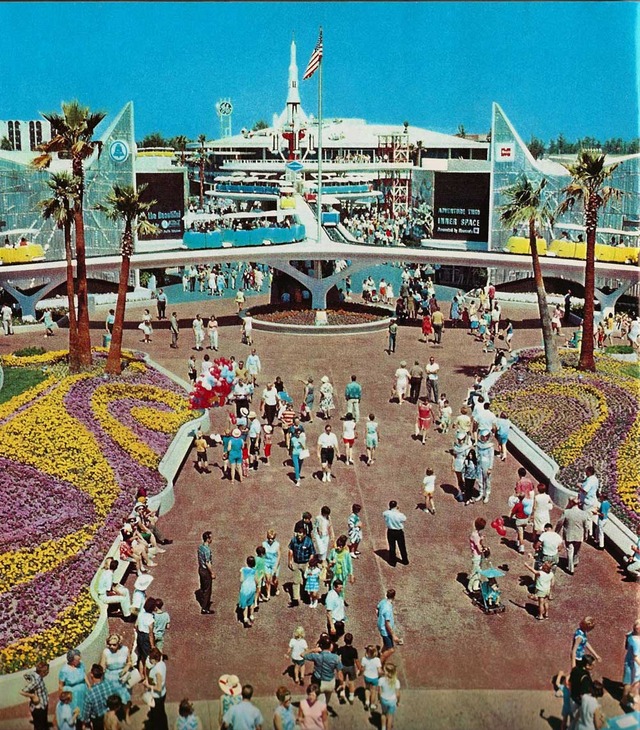
With a New Tomorrowland came a new fresh look. The colors were that of the space age (mostly white).  Everything had a wonderful mid-century style. The architecture was a perfect blend of form and function. The facade of each attraction perfectly fit its surroundings. 

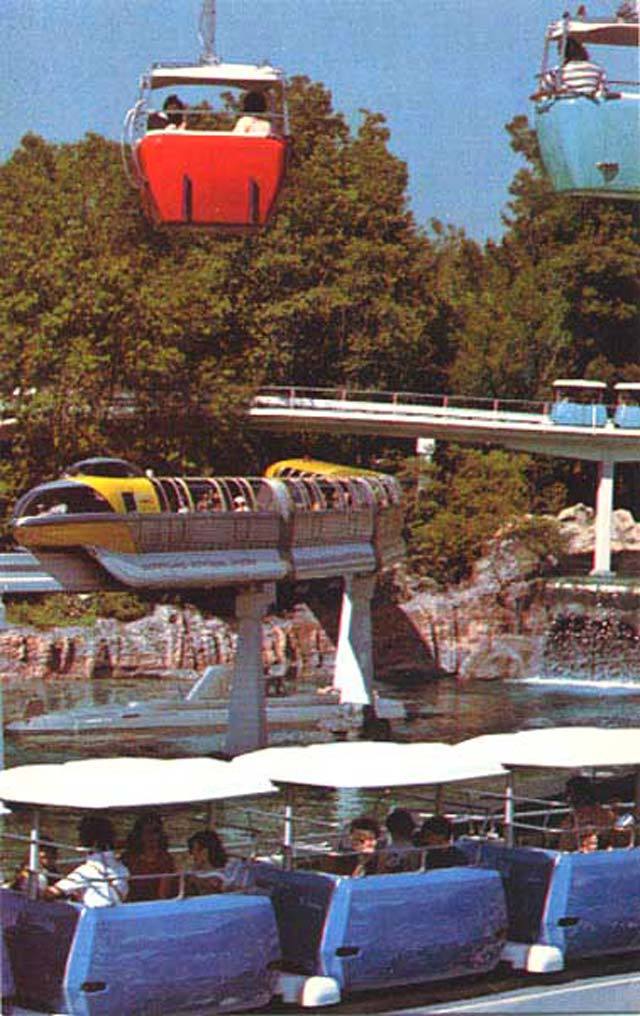
Visible from Disneyland’s central hub were Tomorrowland’s two shiny silver spires which drew your eye from the horizon up to outer space and back down to earth again. A similar effect happened with the main Flight to the Moon sign further west. Below your feet the sidewalks were a beautiful blue. Above you, PeopleMover vehicles traveled smoothly and quietly along a long slender track held up by modern-looking support beams. The PeopleMovers weaved in and out of every Tomorrowland building. A 90-foot rocket atop the PeopleMover station with 12 tiny rockets revolving around it grabbed your attention and drew you further into the land (Walt’s idea). Two deep black cube-like structures turned 45° with raised silver lettering invited you into the new Adventure Thru Inner Space and the CircleVision attractions. Mary Blair’s masterpiece murals added a warm color palette and a charming human touch to both sides of the the main walkways into the land. Soon you would come upon on the many organized and futuristic “levels” made up of the PeopleMover track, Rocket Jets, Skyway buckets, and the 1959 attractions, Matterhorn, Monorail, Submarines. Two entertainment stages offered a variety of musical performances. One of the covered stages slowly and dramatically rose up from out of the ground. The entire first floor of the new round Carousel of Progress building rotated. And at night the charm was even greater. Wonderful lighting set a mood like no other part of Disneyland. It was wonderland of sleek, kinetic edutainment.


A wide variety of themes were presented (inner space, outer space, liquid space, progression of electricity, transportation, etc.) yet everything was presented in a non-conflicting way. (Can the same be said today?? I’m looking at you, Buzz Lightyear). For one, everything fit within the theme of “World on the Move”. Everything. A vague theme perhaps but nonetheless it was a central theme that worked. The “story” of each attraction was presented little-by-little as you approached each non-tacky, non-cluttered entrance. Upon entering, the “theme” was added upon in subtle yet effective ways. Once further inside, you were entirely immersed n the experience. The same experience happened in reverse as you made your way out the exit.

Tomorrowland 1967 Broadcast

If you never got to experience Disneyland's Tomorrowland before say 1995, watch the footage below. If you did experience it first hand, refresh your memory of this how it once was. And as a bonus you'll see some nice footage of other lands via jet pack!

The Most Popular Land at Disneyland

Tomorrowland soon became the most popular land at Disneyland. A decade later its popularity exploded once again with the opening of Space Mountain and the elaborate and ultramodern complex that surrounded it. Walt got his Tomorrowland and in time got his space-travel version of his beloved Matterhorn.

45 Years Later

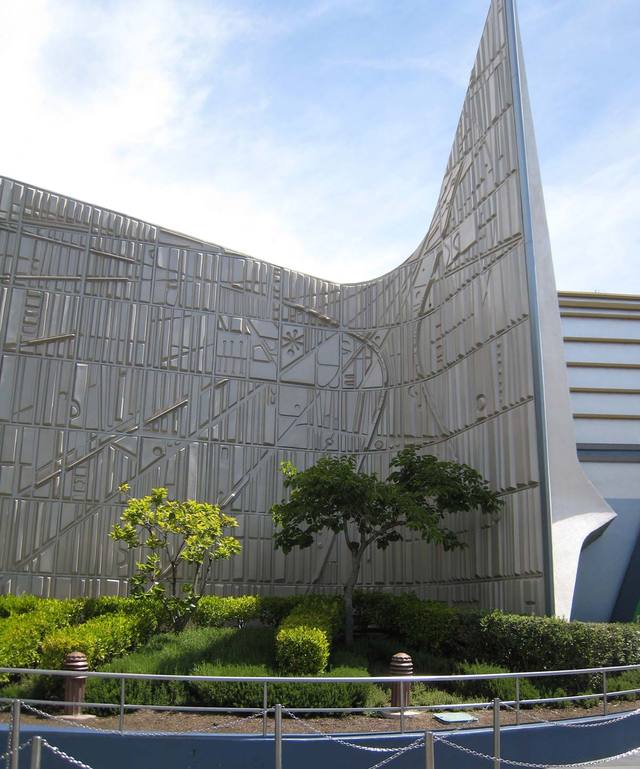
If nothing else, you can go to Disneyland’s Tomorrowland today to look at some of the 1967 architectural remains. That sleek PeopleMover track is still there although it no longer hosts any sort of ride (not even a Rocket Rod). Those silver spires are still there (which is remarkable) and yep, they are currently silver (they were gold or brown or green for a while). Really, every building from 1967 is currently accessible to guests in one way or another. That’s good. The only attraction that opened in 1967 that still remains open is........ well, none of them. The Tomorrowland Terrace Stage is still there and still raises out of the ground. It doesn’t have that wonderful Rolly Crump sculpture atop but it’s quite nice (and it’s white!). 

In this Tomorrowland ‘67 series we will discuss each attraction and explore what still stands today. We hope everyone learns a little more about Disneyland’s Tomorrowland. Stay tuned.


Related posts:

Disneyland in 1955
Revisiting Early Space Mountain
EPCOT City Model [Part 1]
THEN AND NOWDisneyland [Part 1]


Thursday
Jun212012

New Fantasyland 1983

Have you ever wondered where Skull Rock and the Chicken of the Sea Pirate Ship used to be in Disneyland? Did you know Dumbo once flew on the far west side of Fantasyland? And that the Carrousel wasn’t always where it is now? We look at the many changes made during the creation of 1983’s “New Fantasyland”.

We’ve created the above map to help easily compare early Disneyland Fantasyland with today’s version that came about in 1983. In pink you’ll notice just how crowded things were behind the castle. Below that you'll see a photograph of today's Fantasyland with a blue sketch overlay of the original locations of various attractions and buildings.

Photo credit: Jerry and Lorraine Kotler

Huge growth in the early 1980s

The Disney parks saw HUGE growth in the early 80s. Walt Disney World was getting EPCOT Center. Tokyo Disneyland was being built. “New Fantasyland” was Disneyland’s big project. Not long before this, the first two Big Thunder Mountains came about. My earliest memories come from this time. It was EXCITING. Everything made was extremely impressive.

Why all the changes to Fantasyland?

The land was never quite what Walt Disney wanted it to be. With limited time and money the original Fantasyland was built with the idea that it would later be updated with a more “fleshed-out” decor. Facades were created inexpensively. They were designed to look like medieval traveling tournament tents. the story behind the area explains that rides were “brought in” to the castle courtyard for the “temporary festivities”. 

The Storybook Look

It’s often assumed that no European “storybook” facades existed in Fantasyland until 1983 but there were a few. The shops immediately behind the castle, the Skyway station, Matterhorn’s queue, and the miniature buildings in Storybook Land all featured this charming architecture. It is predicted that the Storybook Land architecture would have been the inspiration for Walt’s revisions of Fantasyland had he revised the land.


An Operational Challenge

There was an operational challenge to be addressed. Outdoor rides were placed very closely to the walls of the indoor rides. Narrow walkways created constant pedestrian congestion. The solution? Rip up all the concrete and move rides around.


King Arthur Carrousel

The carrousel was located right between the entrances to Snow White and Peter Pan. It was moved back quite a distance in order to open the funnel of traffic coming from and going to the castle. The move also allowed for larger, more elaborate facades for Show White and Peter Pan. Prior to 1983 no landscaping existed around the carrousel nor was it propped up on a concrete platform.

Peter Pan’s Flight

A London-inspired exterior with a large clock tower was added. 24 new animatronic characters were installed.


Snow White’s Adventures (Renamed Snow White’s Scary Adventures in 1983)

Snow White herself didn’t appear in the pre-1983 ride (other than for short test periods in the 70s). Riders were to experience her adventures from her point of view. Most riders didn’t understand this and just wanted to see Snow White. She was included in the new, longer ride. Show scenes were updated and special effects were added. Outside in the new facade the Queen figure who opens closes curtains was introduced.


Pinocchio’s Daring Journey

What? Pinocchio wasn’t always there? Pinocchio’s Daring Journey was the headliner new dark ride of the expansion. Was it Disney’s first Pinocchio ride? Nope. Shortly before it’s Disneyland debut, Pinocchio opened in Tokyo Disneyland. What was there before Disneyland’s Pinocchio? The space was previously occupied by a theater.

Mickey Mouse Club Theater (Renamed Fantasyland Theatre in 1964)

The theater showed classic Disney cartoons back to back.

Photo credits: (Left) Jerrod Maruyama, (Right) Jerry and Lorraine Kotler 

Dumbo Flying Elephants (Renamed Dumbo the Flying Elephant)

Originally located near the Skyway entrance where the outdoor patio of the Village Haus Restaurant is today. Originally the elephants were to be pink. This was to help preserve the fact that there’s only one Dumbo. Much like there’s only one Mickey. But Walt at some point decided that everyone should get to ride the real Dumbo instead of a pink elephant from Dumbo’s drunken nightmare.

Photo sent by David Blakeslee

And get this. Early Dumbo ears were HINGED!! They were mechanized to flap up and down as the Dumbos flew. This didn't work so well so later vehicles didn't have hinges.


Both 1955 and 1983 versions hosted 10 elephants. A new spinner with 16 elephants was installed in 1990 after a few minor accidents occurred. This new build was intended for Euro Disneyland. A duplicate was created for Euro Disneyland in time for its 1992 opening. Fun fact: All Magic Kingdom-style parks today have a Dumbo spinner. All but Tokyo have 16 elephants. Tokyo still has 10.

For New Fantasyland Dumbo was moved to what used to be a small lagoon where a pirate ship stood for over 25 years.

Chicken of the Sea Pirate Ship and Restaurant (Renamed Captain Hook’s Galley in 1969)

Tuna sandwiches, tuna burgers, tuna pies, and even tuna salad in a little boat were served aboard the wooden ship. This ship belonging to Captain Hook is arguably the most interesting setting of any quick service food counter anywhere. 

After ordering you could sit at one of a few tables on the ship or eat under umbrellas just north of the ship.

The simple lagoon was enhanced with the addition of plant life and Skull Rock in 1960. Guest would exit the dining area on a path that led under the Skull Rock rock work. The ship was renamed when Chicken of the Sea ended its sponsorship in 1969. 

Photo sent by David Blakeslee

The magnificent ship met its fate earlier than planned during the 1983 expansion. They say it was to be moved near today’s Storybook Land queue but upon removal the thing fell apart. Speculations have surfaced in recent years that they could have moved it successfully if they had really wanted to.

An urban legend I ignorantly grew up believing claims that Steven Spielberg purchased the ship to become One-Eyed Willie’s pirate ship in Spielberg’s 1985 film The Goonies. This is simply not possible.

Skull Rock

Added in 1960, Skull Rock featured a waterfall (or several little waterfalls) and its eyes glowed green at night. It was based on Skull Rock in Disney’s 1953 animated film Peter Pan. It was often photographed from above by guests riding in Skyway buckets.

Photo credit: Jerry and Lorraine Kotler

Today rock work and a waterfall stand where the rear portion of Skull Rock was. Do some of the original pieces remain? Probably. The plumbing perhaps?


Skyway to Tomorrowland

The Skyway changed its vehicle style from a round cylinder look to a more boxy look in 1965. The biggest change the Skyway saw in 1983 was a whole new set of views below.


You can still see the old Skyway tower hidden up in the trees.


Mr. Toad’s Wild Ride

Toad’s track and interior were removed. The track was made longer. A few new scenes were added. Part of the new queue featured and outdoor garden. The exterior was built to look like Toad Hall from Disney’s 1949 animated film The Adventures of Ichabod and Mr. Toad.


Alice in Wonderland

The Alice dark ride was not a 1955 original. It opened in 1958. It was the only Fantasyland dark ride built after Disneyland opened and before New Fantasyland in 1983.

Mad Tea Party

The “tea cups” as they are most commonly referred to were originally located where King Arthur Carrousel is today. They were moved closer to Alice in Wonderland which of course makes sense, both being based on the same film. A tented snack bar stood near its new location where The Mad Hatter hat shop stands today. Tables and chairs covered the area now occupied by Mad Tea Party. Each version of the ride has hosted three groups of six spinning tea cups.


Photo sent by Eric Chu


Next time you are strolling through Fantasyland be sure to compare what was then with what is now! Your friends will be oh so impressed.


Related posts:

Disneyland 1955 Model Close-ups
Disneyland in 1955
Not Having Fun at Disneyland
EYE CANDY: National Geographic Aug '63
EYE CANDY: National Geographic Aug '63 [Part 2]